

Snail Mucin vs PDRN: The Honest Comparison
-
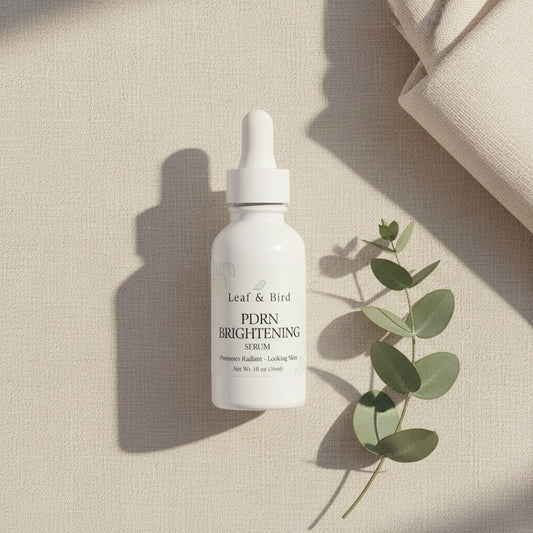
Vegan PDRN Brightening Serum
Regular price $32.00 USDRegular priceUnit price per -
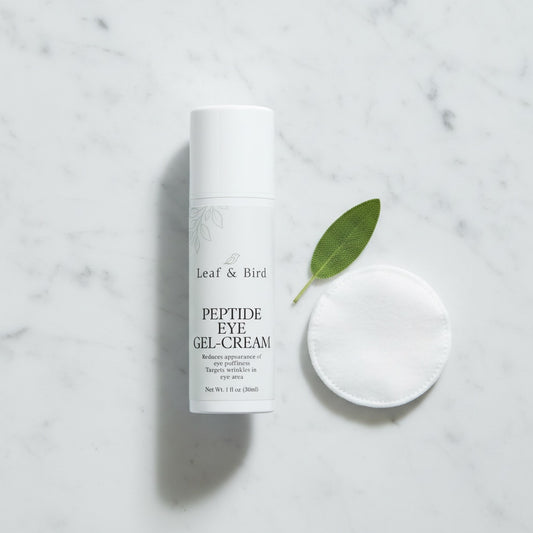
Peptide Eye Gel-Cream
Regular price $35.99 USDRegular priceUnit price per


Snail mucin vs PDRN at a glance
| Snail Mucin | PDRN | |
|---|---|---|
| Source | Live snail secretion filtrate | Polynucleotide DNA fragments (salmon-derived in most brands; vegan non-salmon at Leaf & Bird) |
| Primary mechanism | Glycoprotein surface hydration + mild growth-factor-like signaling | Direct fibroblast activation via adenosine A2A receptors |
| Repair evidence | Modest; mostly sensory and barrier-recovery data | Stronger; clinical evidence for collagen synthesis and wound healing |
| Irritation risk | Very low | Very low (barrier-supportive) |
| Vegan | No (animal-derived) | Usually no (salmon-derived); yes for Leaf & Bird's non-salmon PDRN |
| Pregnancy | Generally considered safe; consult provider | Generally considered safe; consult provider |
| Time to structural results | Marginal structural change; mostly surface-level | 4 to 8 weeks for visible collagen and firmness improvement |
| Typical price (30ml) | $12: $35 | $32: $80 (our vegan PDRN: $32) |
| Clean-beauty fit | Poor (animal product, welfare questions) | Good (when vegan-sourced; we built ours for this audience) |
Pros and cons of each ingredient
Snail Mucin
Pros
- Immediately cushiony, dewy finish on skin
- Very low irritation profile: rarely causes reactivity
- Wide availability; well-established in K-beauty product lines
- Typically affordable relative to peptide or PDRN serums
Cons
- Animal-derived, not vegan and not preferred by most clean-beauty-literate consumers
- Welfare concerns in extraction (no independent standard comparable to livestock certification)
- Weaker direct evidence for fibroblast activation than PDRN
- Structural benefits are modest compared to peptides or PDRN over equivalent time windows
- Ingredient content varies widely by brand: hard to compare formulations
PDRN (especially non-salmon-derived)
Pros
- Direct fibroblast activation with a clinical evidence base
- Barrier-supportive; works well post-retinol and on sensitive skin
- Vegan-sourced option available (non-salmon, non-animal origin)
- No photosensitivity or usage restrictions: AM + PM
- Safer clean-beauty fit with proper sourcing
Cons
- Higher price point than most snail mucin serums
- Most commercial PDRN is salmon-derived: vegan options are rare
- Requires 4 to 8 weeks for visible structural results (no immediate dewy finish)
- Smaller body of long-term use data than snail mucin’s decade of market presence
How each ingredient actually works
Snail mucin: surface hydration with mild growth-factor-like signaling
Snail secretion filtrate is a mix of glycoproteins, glycolic acid, hyaluronic acid, and various proteins. Its well-documented effects are surface-level: hydration retention, mild exfoliation from the glycolic acid fraction, and a cushiony feel from the glycoproteins. Claims that snail mucin drives meaningful fibroblast activation are weaker than commonly assumed. Most of the research supporting “repair” is either in-vitro or relies on formulations with multiple other actives layered in. The glow and plumpness people associate with snail mucin is real but is mostly a barrier-and-hydration story, not a collagen-synthesis story.
PDRN: direct fibroblast activation via adenosine receptors
PDRN, polydeoxyribonucleotide, is a polynucleotide fragment that binds adenosine A2A receptors on fibroblasts. That receptor-level interaction kicks off downstream signaling for collagen synthesis, extracellular matrix production, and tissue repair. Unlike snail mucin's mixed-bag mechanism, PDRN has a specific biological target and a reproducible response. In dermatology it's been used by injection for years, and topical formulations deliver a meaningful fraction of the same effect. See our PDRN guide for the full mechanism.
The ethical gap: sourcing is the whole game for most consumers
Snail mucin cannot be made vegan by any formulation choice. PDRN can: our non-salmon-derived PDRN uses a vegan biological origin. For the clean-beauty and clean-beauty audiences, this is the determining factor. See is PDRN vegan for how we verify sourcing and is PDRN salmon sperm for why most commercial PDRN isn't vegan.
Three common misconceptions about the snail mucin vs PDRN debate
Myth: “Snail mucin is basically natural PDRN.”
This comparison keeps circulating because both claim fibroblast support. In reality, PDRN is a specific polynucleotide that binds a specific receptor; snail mucin is a biological cocktail with many components and a much less specific mechanism. They deliver overlapping sensory results but not equivalent biology.
Myth: “Vegan PDRN is impossible. All PDRN is salmon-derived.”
Most PDRN on the market is salmon-derived, which is why the myth persists. Non-salmon, non-animal PDRN exists but is rare. We sourced ours specifically to close the gap for vegan and clean-beauty consumers. Read our is PDRN vegan article for the sourcing walk-through.
Myth: “PDRN is just a more expensive snail mucin.”
Price reflects ingredient cost, not marketing markup here. PDRN is expensive to produce because the purification process is demanding and the vegan version is harder still. A $12 snail mucin serum and a $32 PDRN serum aren't the same product at different margins: they're different biology with different cost structures.
Which should you choose?
Choose snail mucin if: you're comfortable with animal-derived skincare, your primary goal is immediate surface hydration and a dewy finish, and cost is a major factor. Snail mucin at its best is a perfectly defensible ingredient for consumers without ethical constraints on animal products.
Choose vegan PDRN if: you're a vegan, a clean-beauty skeptic avoiding animal-derived skincare, or a clean-beauty consumer who wants fibroblast-level repair with a better evidence base than snail mucin offers. Our Vegan PDRN Brightening Serum is the product we'd recommend. See also our vegan PDRN collection and flagship PDRN serum page.
Choose both (strategic layering): some K-beauty enthusiasts use snail mucin essence for surface hydration and PDRN serum underneath for structural repair. If animal sourcing isn't a dealbreaker for you, this combo is the most-of-both-worlds play. We personally don't use snail mucin because of the sourcing, but we won't pretend it's a bad ingredient. It's just not for our audience.
For pregnancy: both are generally considered lower-risk than retinoids. Always consult your provider. See pregnancy-safe skincare for the broader framework.
The honest bias disclosure
We sell PDRN. We don't sell snail mucin. That bias colors this comparison, and we want to name it directly rather than let it hide behind a veneer of objectivity.
Our position: if you have no ethical constraint against animal-derived ingredients and you're happy with snail mucin, we're not here to change your mind. What we're saying is narrower: for vegans, clean-beauty skeptics, and clean-beauty consumers who want the fibroblast-repair benefit without snail sourcing, non-salmon-derived PDRN is the better match. We built ours specifically for that audience.
Leaf & Bird is a clean vegan skincare brand making rare non-salmon-derived PDRN serum and grass-fed tallow creams, formulated for the ingredient-literate. If the comparison above resonates with your goals, our PDRN serum is the product we'd recommend you start with. If it doesn't, your current snail mucin routine is probably fine. We just won't be the brand that pretends otherwise. For the full narrative version of this comparison, see snail mucin vs PDRN: which is right for you.
Snail Mucin vs PDRN: common questions
Is PDRN better than snail mucin?
Can I use snail mucin and PDRN together?
Is Leaf & Bird's PDRN vegan when most commercial PDRN is salmon-derived?
Does snail mucin work on fine lines and wrinkles?
Why is PDRN more expensive than snail mucin?
What's the cleanest replacement for a snail mucin essence?
About This Collection
Every Leaf & Bird product is formulated with full ingredient transparency: real ingredients, real results, no compromises. Made in the USA without synthetic fragrances, artificial preservatives, or harsh chemicals.
Frequently Asked Questions
Find answers to common questions about our products, shipping, returns, and more.
Every product is formulated with full ingredient transparency. We use clean, natural ingredients. No synthetic fragrances, no artificial preservatives, no harsh chemicals. All products are made in the USA and come with a 30-day money-back guarantee.
Yes! All orders ship free within the United States. Orders are processed within 1-2 business days and typically arrive within 5-7 business days.
We offer a 30-day money-back guarantee on all products. If you're not completely satisfied, contact our support team and we'll issue a full refund. No questions asked.
Our products are formulated without harsh chemicals, synthetic fragrances, or artificial preservatives. We recommend a patch test before first use if you have known sensitivities. Our grass-fed tallow products are especially gentle.
For hydration & dry skin: Start with our Tallow Body Care collection. For brightening & anti-aging: Try our Vitamin C or Vitamin Glow serums. For deep pore cleansing: The Dead Sea Mud mask. For overnight repair: Sleep Plus Collagen Cream.
What Our Customers Are Saying
Clean Beauty That Works
I've been shopping with this brand for over a year now and the quality never disappoints. Every purchase has exceeded my expectations and their customer service is exceptional.
My Whole Routine in One Brand
I've been shopping with this brand for over a year now and the quality never disappoints. Every purchase has exceeded my expectations and their customer service is exceptional.
Finally, Transparent Ingredients
I've been shopping with this brand for over a year now and the quality never disappoints. Every purchase has exceeded my expectations and their customer service is exceptional.